


Identification of the larvae of common European Lucanidae
There are just a few species of the beetles of Lucanidae family found in Europe, with the biggest one being European stag beetle, Lucanus cervus cervus. The species of this family which can be found in the United Kingdom are Sinodendron cylindricum (sometimes called Least Stag Beetle), Platycerus caraboides and Dorcus parallelipipedus (Lesser Stag Beetle). Apart from the European and lesser stag beetles, the other two do not look much as stag beetles since their males do not develop impressive mandibles. Although the larvae of the Lucanus cervus is considered polyphagous and often found feeding on decaying roots of garden trees or rotting fence posts, their typical food source is normally associated with decayed wood of hardwood trees such as oak or beech. Despite the fact that the stag beetle's larvae occasionally found above the ground, e.g inside of heaps of decayed woodchips, their larvae is usually live underground in their natural habitat. Similarly, sinodendron cylindricum larvae is also usually found in decayed oak or beech wood. In contrast the lesser stag beetle larvae also can be found in decayed wood of various deciduous trees, often in logs above the ground and often in big numbers. In our South London area I often find these inside of decayed poplar logs above the ground, and normally adults beetles can be found in the same rotten log with the larvae.

The least stag beetle, Sinodendron cylindricum, despite that it belongs to the lucanidae family, looks more like a rhino beetle. The photo shows a (dead) female of the species which was found in Mitcham park in South London.

The lesser stag beetle, Dorcus parallelipipedus male looks as a smaller version of the minor male of lucanus cervus cervus.
Obviously it always interesting to know what lucanidae species is the larvae that you found. However, because the larvae (particularly the smaller one) of all lucanidae look pretty much the same, it is very difficult to determine to which species the larvae belong to. This is particularly applicable for the dorcus parallelipipedus and lucanus cervus cervus, as the late L3 larvae of the DP could be as big as early to mid L3 larvae of the LCC. Considering the fact that DP is an abundant widespread species and normally live in the same areas as LCC this could be quite an issue. However, apparently it is still possible to identify the larvae of the common UK's lucanidae by comparing the shape of their last (terminal) segments. Here I came across the diagram published by T.E. Leiler in 1950 which could be useful:)
The diagram below shows the caudal and ventral view of the last segments of common lucanidae larvae

Leiler, T.E. (1950) Bestimmungstabelle der schwedischen Lucanidenlarven (Coleoptera). Opuscula Entomologica, 15, 157–160.
Contact email: beetlesaspets@gmail.com
Exotic beetle larvae for sale, 2015 spring list (updated 6.04)
Post to most of the countries, please ask for p&p charges before ordering.
UK postage 1st class RM £4.99
Europe postage for small parcels £6 (at buyer's risk) or £11 recorded.
Payment by bank transfer, Paypal or cash on collection.
Contact email: beetlesaspets@gmail.com
1. Dynastes hercules lichyi L1-L2 larvae for sale. L1- £8 each or £7.5 for 10+ larvae. L2 £8.5 each or £8 for 10+ larvae. Larvae are from a massive ~140 mm male parent.

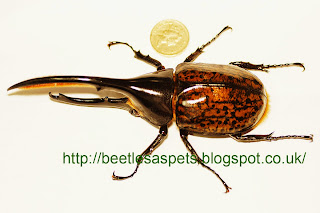

2. Dynastes Hercules Hercules L1 larvae for sale. L1- £8 each or £7.5 for 10+ larvae. Larvae are from a big ~140 mm male parent (photo below).

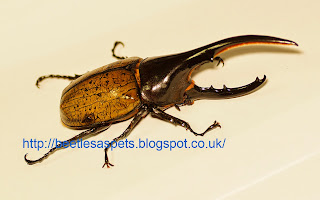
3. Mecynorrhina torquata ugandensis, brick orange colour parents (see photo) L1 larvae, £4.50 each or 5 for £20

4.Megasoma elephas elephas L1 larvae for sale. Only 4 larvae left, £8 each.
Massive parent male (on photo). SOLD

5.Dynastes tityus, the Eastern Hercules beetle, L2 larvae for sale, £4 each,
only 8 larvae left for sale. SOLD

reade more...
UK postage 1st class RM £4.99
Europe postage for small parcels £6 (at buyer's risk) or £11 recorded.
Payment by bank transfer, Paypal or cash on collection.
Contact email: beetlesaspets@gmail.com
1. Dynastes hercules lichyi L1-L2 larvae for sale. L1- £8 each or £7.5 for 10+ larvae. L2 £8.5 each or £8 for 10+ larvae. Larvae are from a massive ~140 mm male parent.


2. Dynastes Hercules Hercules L1 larvae for sale. L1- £8 each or £7.5 for 10+ larvae. Larvae are from a big ~140 mm male parent (photo below).


3. Mecynorrhina torquata ugandensis, brick orange colour parents (see photo) L1 larvae, £4.50 each or 5 for £20
4.
5.
The Western Hercules Beetle, Dynastes Granti, breeding report
Some time ago I purchased 3 late L3 larvae of Dynastes granti as an impulsive buy:). One larvae died in a few days and the other two successfully molted into the pupae after the month or so. I did not check their sex initially, so was a bit disappointed as they both turned out to be females. By the time they eclosed into adults, it was winter here in the UK and purely out of pity I purchased the male from Asia for something like 5 times its normal "seasonal" price. Luckily, we had a few relatively warm days here, during which he arrived safely. Here is the brief breeding report.
Setup and adults: A 40 litre plastic box filled with garden soil/peat/rotten oak wood and leaves mixture. Wood and leaves were mulched well into small particles and mixed with soil (garden soil/peat mixture), with 1:9 ratio. Bottom 15 cm layer was pressed firmly. Top of the soil was covered with small logs, sticks and leaves. I used my beetle jelly recipe (http://beetlesaspets.blogspot.co.uk/2013/11/jelly-for-tropical-beetles-at-home.html ) and ripe banana sprinkled with diluted honey for adults, which they loved and consumed lots of it. The temperature was 25C day and night. The box had only a few small holes, so the humidity in the container was high all the time. Once the females became active they started to come out and feed. The male was guarding food and and stayed close to the feeder all the time.

Eggs: I made the first dig after about 8 weeks when the females became active and started feeding. I dug up 50 eggs. The majority of the eggs were deposited very close to the bottom of the container, some of them were literally at the plastic bottom of the container. I rearranged the soil in the box and let the beetles into the container again.
After another 6 weeks when the male died and the food was not touched for a several days I made another dig and discovered that both females were dead and removed another 38 eggs from the soil. I was pretty satisfied with my results obtaining 88 eggs from two females. Interestingly, it may take ages for eggs of dynastes granti to hatch; first eggs started to hatch after about 8 weeks, while some hatched only after 6-8 MONTHS!!! Some of my larvae were solid L3, when the late eggs just hatched.
 Larvae: The larvae of the Western Hercules beetle turned out to be pretty hardy, similarly to the Eastern Hercules beetle (dynastes tityus) larvae. I tried both oak rotten wood and decayed oak leaves substrates and they were doing just fine. Moreover, I even switched the substrate during the development of the small group of larvae, and observed that it did not affect their development drastically. I also had very low die out percentage of the larvae; may be just one or two out of the whole lot.
 I found the breeding and rearing of these species quite easy. The only pity is that such beautiful beetles do not live long as adults, just about 3-5 months.